TLPS 2025 is India’s first large-scale, multi-state study that examines how teaching and learning take place inside early-grade classrooms.
It goes beyond assessments to understand how teaching and learning of language and mathematics unfold in Grades 1 and 2. It was conceptualised to provide systematic, national-level evidence on teaching practices for language and mathematics.
States in India
0
Districts
0
Classrooms Reached
0
Organizations
0
UTTAR PRADESH
Classroom Observed & Teacher Interviewed: 200
Distict: Bahraich, Bareilly, Raebareli and Mirzapur
Some of the main findings from the Survey are:
1
In two-thirds of the classrooms, children were mostly quiet and had few opportunities to speak freely, engage in conversation with the teacher, or learn from one another.
2
Although 73% teachers knew the children’s home languages, only 10% used them consistently to enhance children’s participation and comprehension.
3
Over half the teachers relied on asking questions to the whole class, which elicited a choral response from the children. Very few teachers checked for individual children’s understanding through varied methods.
4
Only 30% of teachers used differentiated teaching strategies to support children at different learning levels.
5
The use of children’s real-life experiences and open-ended questions to encourage children to think and express themselves during oral language activities was limited.
6
The teaching of decoding was not systematic and relied either on writing letters and words or on just one activity to reinforce sound-symbol association and blending.
7
In 53% of classrooms, children did not use TLMs at all.
8
More than half the teachers gave children mathematics tasks to work independently. Overall, 16% teachers observed the children, corrected their work, and provided feedback.
9
The analysis of children’s activity reveals that children remained off-task for over a quarter (27%) of the class time. When children were ‘on-task’ (73% of time), they spent 32% of the class time listening to or watching at either the teacher or another child reading or copying from the blackboard. They also spent 17% of the time engaged in choral repetition or choral response.
TLPS 2025 includes two types of recommendation:
Classroom Level
Grounded in survey findings
Drawing directly on the Survey’s main findings, TLPS recommends that teachers create a better balance between teacher-centred instruction and learner-centred practices to enhance children’s engagement with learning. Teachers should also plan and manage independent and group tasks more deliberately, especially in multigrade contexts where attention is divided.
System Level
To enable and sustain effective teaching practices
Continue and extend policy support for Foundational Literacy and Numeracy (FLN).
Integrate a strong FLN focus within pre-service teacher education programmes.
Build a coherent, practice-focused system of continuous teacher professional development.
Address home language use, multigrade teaching, and differentiated instruction systematically.
Expert Speak
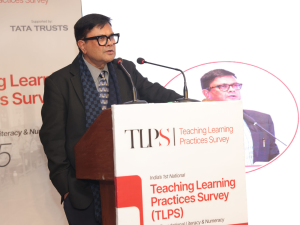
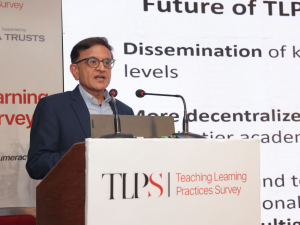
“I am happy to see the release of this study, the Teaching Learning Practices Survey (TLPS). The findings provide a strong evidence base. Given the scale of the sample, the insights emerging from this can be seen as reflective of teaching and learning practices across the country.”
– Shri Sanjay Kumar, IAS, Secretary, Department of School Education and Literacy, Ministry of Education, Government of India
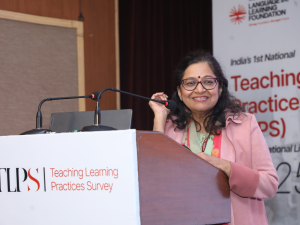
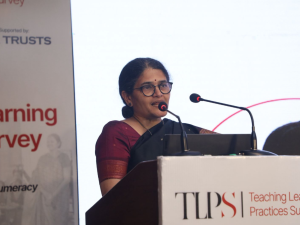
Smt Archana Sharma Awasthi highlighted how the NEP 2020 policy can be brought into action in classrooms through joyful and play-based learning and by using children’s most familiar languages for early learning.
– Ms Archana Sharma Awasthi, Joint Secretary (Samagra Shiksha-l& Adult Education), Ministry of Education, Government of India
Dr Dhir Jhingran, Founder and Executive Director, LLF, emphasised the need to strengthen student learning and engagement:
“We are really happy to have completed India’s first national survey of teaching and learning practices for foundational learning in partnership with several other organisations. Student learning can improve only when children are actively engaged in learning. We hope this report can trigger a nation-wide discourse on the need for transforming teaching and learning for young children in early grades in primary schools in India.”
Highlighting the importance of sustained, evidence-led reform, Ms Amrita Patwardhan, Head, Education, TATA Trusts, noted:
“TLPS is a significant study for its sharp focus on understanding teaching-learning practices of language and mathematics in grades 1 and 2. The findings provide vital pointers for improving instruction in early grades by keeping meaning-making at the centre. It is time for us to join hands to support teachers in bringing about the much-needed shifts in classroom practices”.
Study conducted by
Language and Learning Foundation (Chhattisgarh, Haryana and Uttar Pradesh)
Partners
Supported by
Evaluation agency
2030 MISSION
By 2030, we will reach 6 crore children by influencing the classroom practices of more than 20 lakh teachers and teacher educators. We are committed to supporting the government’s mission to ensure that all children have strong foundational skills.